Plastic recycling has long since been trying to keep up with the amount of plastic that is manufactured across the globe.
It is estimated that 380 million tonnes of plastic is currently being produced worldwide, each year. To put that into perspective, that’s about equivalent to the weight of 3,800 standard cargo ships.
And with approximately 16% of this plastic currently being recycled, that leaves around 319 million tonnes of plastic that is burned, dumped, and landfilled across the globe on an annual basis.

As a time-sensitive issue, this matter has become more pressing each day and is forcing governments, leaders, and businesses to take charge of the plastic problem and find new ways to tackle the situation at hand.
One of the latest solutions to be brought to life by Mura Technology in the UK is the world’s first commercial-scale all-plastic chemical recycling plant.
Due for completion in 2022, this plant will act as a blueprint for further facilities planned across the US and Germany; with a goal to work in tandem with mechanical recycling, towards a more circular economy.
The chemical recycling plant, based in Teesside, UK, aims to process 80,000 tonnes of previously unrecyclable plastics each year using 40% renewable energy.
Met with a widely positive reception, this plant which is still in its infant stages has been commended for its ability to turn plastics back into oil – thereby closing the loop on the plastic lifecycle.
Mura’s chief executive, Steve Mahon, has said: “The hydrocarbon element of the feedstock will be converted into new, stable hydrocarbon products for use in the manufacture of new plastics and other chemicals.”

Scientist Sharon George has praised Mura on their aims to produce “virgin-equivalent feedstocks”, saying that “’unmaking’ the plastic polymer to give us the raw chemical building blocks to start again.”
But while some have welcomed this new solution to the plastic problem, others remain unconvinced that the plant will be able to side-step the challenges that have led to the demise of its predecessors.
Historically, chemical recycling has been widely avoided due to its energy-intensive demands and unscalable nature.
With these complexities in mind, Mura has designed their chemical recycling plant to use a “hydrothermal” technique, with future aims to achieve 100% renewable energy.
Unique from any other plant, Mura’s “hydrothermal” method of feedstock recycling uses “supercritical” water to heat evenly from within the reactor chamber.
As opposed to the standard method of heating from outside the chamber, Mura claims that this way of heating the feedstock will make their plant inherently scalable.
Rather than competing with existing recycling processes, Mura’s upcoming development aims to complement the infrastructure by focusing on the plastics that would normally be sent to landfill, incineration, or the environment.
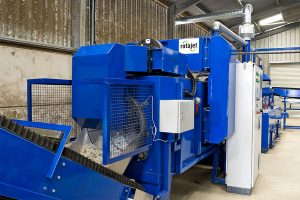
By collecting plastics that have slipped through the filter of other recycling processes, Mura aims to act as a catch-all for these materials to help to close the loop on plastic production.
However, the issue still remains that in order for chemical recycling to fully close the loop on plastic production, facilities like Mura’s will need to be developed at scale: for which a great deal of funding is required.
The New Plastic Economy Project Manager and the Ellen McArthur Foundation, Sara Wingstrand, has addressed these concerns, stating that the level of “dedicated, ongoing and sufficient funding” required to tackle the plastic problem would rely upon more mandatory Extended Producer Responsibility Schemes.
Whilst the UK government has worked to introduce schemes such as the Plastic Packaging Tax and plastic carrier bag levies, many still believe that there is still a long way to go before the required level of funding – and circular economy – can be achieved.
For information on UK government plastic levies and regulations, read our Plastic Packaging Tax press release.
If you are looking to invest in plastic recycling plants and machinery, you could be eligible for the UK government’s Super Deduction scheme. Find out more about the scheme and eligibility criteria here.
